






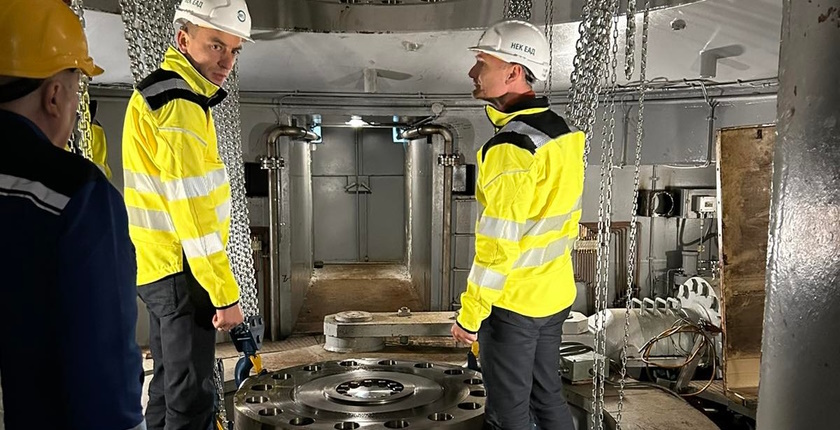
Photo: Ministry of Energy


The Chaira pumped storage hydropower plant, which suffered a major breakdown last year, is about to be reconstructed, Minister of Energy of Bulgaria Rosen Hristov said. He estimated the project at EUR 102 million and said it should be completed in 2025.
The largest pumped storage hydropower plant in Southeastern Europe has been out of order for a year, worsening the energy crisis for Bulgaria. Government-owned National Electricity Co. (NEK) couldn’t store electricity in the Chaira system when it was cheap so that it could sell it at higher prices later. At the same time, lack of storage hampers the deployment of intermittent renewable energy sources – primarily solar and wind.
Rehabilitation efforts were stretched over several years, culminating in the destruction of one reversible turbine in March 2022 during testing. The last functional unit broke down in May.
Two out of four aggregates can get back online after emergency repair
It will take EUR 102 million to reconstruct all four units at the pumped storage hydropower plant in southern Bulgaria, according to Acting Minister of Energy Rosen Hristov. The project is expected to be completed in 2025, he said during a visit to the facility and added that, first, two aggregates can undergo emergency repair and get back online at a cost of EUR 5.1 million each.
Experts from Toshiba are about to arrive at Chaira to conduct a more detailed analysis. The Japanese company built the first two units, which were commissioned in 1995, and its technology was used in the installation of the other two. They are in operation since 1999.
Rehabilitation project to be funded by NEK, external sources
The repair works will be funded by NEK and from external sources, Hristov revealed. The hydropower plant operator and electricity supplier and trader is part of state-owned utility Bulgarian Energy Holding or BEH.
“The Chaira PSHPP is extremely important for Bulgaria’s energy sector, as it is a giant energy storage system. With the introduction of more and more renewable energy sources, these systems are key,” the minister stressed. The facility has a generating capacity of 864 MW in total while in the pumping regime it operates at a maximum of 788 MW. Downstream from Chaira is the Sestrimo hydropower plant, of 240 MW.
According to Bulgaria’s draft energy strategy until 2053, Chaira’s capacity would be expanded.


Be the first one to comment on this article.